From Dialogue to Doing: Embracing Risk to Transform Governance and Community
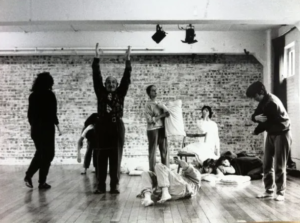
Memoirs of a Cast of Thousands, A CDS production
Transformational governance is exemplified with blogs like this, written by people like me.
My name is Valerie Uchechukwu Ebuwa. I am a freelance independent choreographer, dance artist, writer and model.
I do not hold the title of CEO,
Artistic Director,
Executive Producer
or anything that implies that I am someone who sits in a position of power yet here I am writing to you about the two year journey that Chisenhale Dance Space (CDS) has embarked on to attempt to do governance differently and my active role within that.
The ‘differently’ bit refers to a few extremely difficult and pressing questions:
- Can Chisenhale Dance Space be truly anti-ableist and anti-racist in its current organisational structure (a charity based in a building that has no step free access)?
- What does it actually mean and look like to be an artist-led organization?
- How can we distribute power and leadership to those whose knowledge has been historically overlooked/silenced?
- Finally, how can we create effective channels of communication between board, staff and artist community that allows for these differing groups to organically connect to one another without staff being the only conduit?
These questions are still ongoing and CDS is not pretending to anyone that they have all the answers.
Here is an honest account on the last two years of soul searching and what other organisations could do to make their spaces more equitable.
—
Chisenhale Dance Space’s Radical Roots
Chisenhale Dance Space was started in the 1980’s by a group of artists called the X6 Collective, known for their anti-hierarchical, alternative and independent ideologies in a very company focused, hierarchical and male-dominated contemporary dance scene. After facing eviction from their previous home in Bulter’s Wharf, the X6 collective famously removed the maple wooden flooring and installed it in the derelict vanish factory now known as Chisenhale Dance Space.
45 years on, artists such as myself old and new, dance, shake, sing, converse and commune on that floor. Since its inception, CDS has always been artist driven, looking for alternate ways to work, make and convene.
CDS has gone through a myriad of changes in leadership and organisational structures over the years, from its inception as a member-led co-op to its current trustee-led structure which was implemented in 2017. However, throughout this time, it has always been a charity.
From a personal standpoint, I think that charities exacerbate colonial frameworks, particularly because of the mandate of a board and the unspoken privilege needed to have and sustain such a position (and that’s even if you’re aware of, confident enough in your ability to apply and make it into said position). Because of this privilege, these rooms are often filled with people who don’t share the lived experience or have the knowledge of the people in which they’re making decisions about and for and this can have quite dangerous consequences.
I do however understand why becoming a charity is helpful, particularly as it pertains to the wealth in funding options it creates. In a sector that is consistently cash poor and artist rich, finding multiple funding strategies and pools is critical.
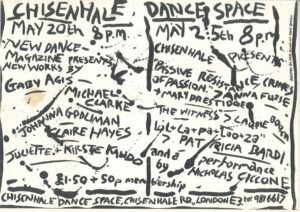
New Dance Magazine presents new woks, early 80s.
CDS began as a membership. It was always imagined as a collective / co-op so as artists joined, they became a part of the collective which allowed them to vote on how the organisation operated. Also, for most of its history, CDS’s membership model meant that you could only be a member if invited by another member. Over time, what it became was a microcosm of the wider dance sector; very white and pretentiously superficial in its attempt to be an alternative to general mainstream antics.
In 2017, CDS shifted to a trustee-led constitution, meaning legal decision making was taken away from artists. This was necessary as it was impossible to make decisions on how to run the organisation due to the 80+ artists with varying engagement who had decision making power. Many of the 80+ artists stayed on to be a part of the new non-legally binding membership model, some left.
Over the following years, and before the pandemic struck, there was recognition that there was still more to be done to shift the elitism and exclusionary environment at CDS and conversations emerged which led to the beginnings of a steering group in 2020. This gesture provided the first step of CDS moving back to its artist-led genesis and specifically relevance for the artists of today. Ironically, the constitutional change in 2017 of removing decision making power from artists propelled the change needed in order to find a different and arguably better way of alternative, artist-led decision making, spearheaded by those who have been historically excluded. This decision may not have come to pass so easily or at all with the pre 2017 structure. The group conducted a research into the current membership via questionnaire and deduced that current membership wasn’t working. The success of this group allowed for its continuation in the form of the CDS artist committee in which I served from 2022–2024.
The CDS artist committee is a group of 6 artists from the community who identify as either a person of the Global Majority or disabled (or both). This position is held by each artist for two years to ensure that power is fairly distributed and not hoarded.
These communities are often excluded from leadership roles or positions. If CDS wanted to enact real change, then it required putting these voices at the centre. This group was paid and met monthly to lead the organisation and help with decision making. This meant that there were 3 groups leading CDS — the staff, the committee and the board of trustees.
After the committee decided and documented our values and how we would like to work together, we very aptly reformed the membership to what is now the ‘Artist Community’: a 250+ pool of artists living across the UK. 70% of which identify as Black/Brown or of the Global Majority and disabled/neurodiverse
At the centre of this reform was the recognition of a CDS that at its core, is committed to creating an actively anti-racist and anti-ableist organisation and community.
Successful communities often consist of people that have definitive role/s so we decided that there were two ways one could participate: an activator is one of 60 artists, identifying as either as Black or Brown or Global Majority or disabled and/or neurodivergent or both. These artists literally activate the space and community. The expectation within this role is that these artists have a larger contribution and are central to CDS and its direction. The activators meet once a quarter and decide talking points that are taken to the artist committee meeting for further discussion.
The second role is the collaborator. These artists exist more on the periphery of the community and support the activators. The expectation of input and activity is slightly less. Once we worked out these roles, we did a callout and invited artists to apply. Some ex-members stayed and became a part of the artist community, others left as we welcomed a new cohort of artists to start this new journey with us. The selection process consisted of anonymised applications, screening answers which matched our new intentions for the community and also randomised lottery selection to make this undertaking as fair and unbiased as possible. Each artist has two years in the community in which after the first, there’s a check in to assess how things are going.
We’re coming to the end of the 2nd year of this reimagined way of working and getting ready to do another big callout. CDS has an energy that is urgent and necessary unlike its previous lethargy and stagnance.
One thing that I would like to acknowledge is the ickiness of the decision of the make up of Activators. We spent a while debating on the numbers/percentages and which marginalised groups to focus on which was deeply uncomfortable. I believe that many organisations prioritisation of certain marginalized groups are often tokenistic at best so finding myself in a position in which I’m amongst decision makers made me empathetic. Creating a lottery with built in commitments to diversity to ensure these artists had a better chance of being selected felt like the best way to serve our community although it implies unintentionally that these identities are experiencing the same sharpness of oppression. I often ponder if the numbers should be different and if so, in which direction/who should be favoured and why.
There is however, a grave misconception that inclusivity means open for all. It’s about a generality. Generality ignores the barriers people face in order to participate. It is specificity that allows us to move closer to spaces where diversity and inclusivity are core values, resulting in a shift of narrative rather than the repetition and inevitably of those with privilege gaining access to and hoarding more privileges. There is a really fine balance that we consistently wage at CDS of being open and inclusive yet still needing a way of shaping and curating something that ensures its purpose and intention within its design. This, as I said in the beginning, is one of the many illustrations of the difficulties we faced when transforming this organisation.
We can’t question a structure if we don’t know how it works…
Once we established the new community, we took a deeper look at the ways in which power is held at CDS. Even though the artist committee holds power to some degree, the legality of power lies with the board of trustees. This has led to many discussions about definitions of power, the nature of charitable structures and if being a charity is serving CDS’s current vision. We are still in the thick of figuring this out. As a result of these discussions, we created two paid conduit roles to aid conversation between the board and the committee to allow these groups to interact with and work together. We can’t wholly question the structure if we don’t know how it works.
One person from the board is to attend an artist committee meeting quarterly and a member of the artist committee is present at all board meetings. Once a quarter, the two conduits meet to discuss how both groups can benefit from each other and what we’ve learned from attending these sessions. I was the first artist to take on this role. For those who are interested in the experience of being on a board but do not have the resources (time, financial security, legal knowledge etc.) to make it happen and for charities that want to diversify their board meetings, I think this is the perfect way to break barriers and bring voices to the table that otherwise wouldn’t be heard.
The artist committee is very action orientated so I felt that I brought that energy and sense of urgency to the board meetings I attended. An interesting observation I found was due to the time constraint (amongst other things), I feel like board meetings in general are mostly strategic and leave almost no room for dreaming or creativity. This is not limited to just boards.
My experience engaging with arts conservatoires in regards to anti-racism is painfully similar. Interestingly, I think dreaming and thinking creatively is exactly the kind of thinking a board meeting needs in order to really transform ideas around leadership and governance. Maybe due to the lack of legal positionality of the artists committee and more time for discussion, there is a freedom to approach decisions and leadership with dynamism and originality. It was incredibly useful for us all to learn about both groups and how we can be useful to each other and indeed for CDS. This role is currently under evaluation but the commitment has been made to keep the role as it is indeed invaluable. This a great step towards unpicking and shifting power within a charitable structure.
Finally, the inaccessible space has led to decisive action including the formation of partnerships with accessible spaces as well as the inquiry of obtaining another space which has created the talking point of CDS consisting of two entities in its actuality: the physical space and the artist community. Both can co-exist but they do not have to have each other to exist. This realisation was a massive step towards a less ableist future. The artist committee brought the often avoided and background conversation about the inaccessible building to the forefront, allowing it to be acted on and confronted rather than dismissed. The result has now seen CDS make a commitment to securing a new accessible studio space by 2027. The future of the building isn’t certain but the future of the community is.
—
These last two years haven’t been easy.
I have cried out of frustration, sadness and indeed laughter.
Any organisation with a mission to reimagine systems has to consistently show up, be willing to engage in conflict and sit in discomfort, especially when the “we did this and we fucked up” moments occur (and if you’re doing the work, these will probably occur more frequently then not).
Even though it’s good and needed there is also only so much listening and talking that we can do. We must act, this is where true change and progress lies. There is of course the element of risk but when is there not in business? Avoiding risk shouldn’t be the reason for inaction and passivity.
Leadership and the struggle to find the “perfect” structure is something to work towards with no tangible fixed point or end. This idea welcomes a consistent flow of questioning, dynamism and failure to be a necessary part of the journey.
Can CDS ever be truly anti-racist and anti-ableist in its current charitable structure? Can any organisation?
I don’t know. But I believe that we will try our best to do so.
Can we distribute power and leadership to those whose knowledge has been historically overlooked/silenced?
Yes I think we can and we have but there’s still so much more work to be done. There’s still holes to be filled and new ideas to be tested.
How can we create effective channels of communication between board, staff and artist community that allows for these differing groups to organically connect to one another without staff being the only conduit? We did but these need to be revised and refined.
It’s a start but I have a feeling the best is yet to come.
This blog post was published as part of the Power Shift: Community Value Exchange Commissions. Originally published on Medium.
by Valerie Ebuwa, Oct 2025.